Ibraa Private School
Are you a representative of the school? Contact us
We will help you get the information
Omani
Education in Ibraa Private School follows the Omani curriculum, balancing Arabic with foreign languages
School Facilities
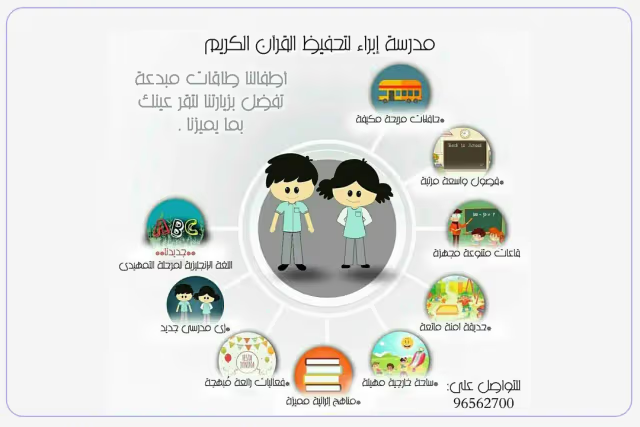
Ibraa Private School Kindergaten features state-of-the-art facilities including scientific laboratories, a comprehensive library, and advanced sports facilities to meet students' needs.
School Fees
Starting from 590 OMR
About the school
Ibraa Private School for Quran Memorization (Ibraa Private School) — also known as the Waqf Qur’anic School in Wilayat Ibra, North Al Sharqiyah Governorate, Sultanate of Oman — is an educational institution that aims to promote the memorization and proper recitation of the Qur’an among community members according to high educational and religious standards.
The school was established in a spirit of community solidarity. It upholds Islamic values and seeks to raise a generation that is both religiously literate and morally upright, aiming to graduate Qur’an memorizers capable of distinguishing themselves locally and internationally.
To become a leading educational institution in the field of Quran memorization, ensuring a nurturing environment based on both authentic and contemporary Islamic values, and contributing to the preparation of a generation that is proficient both Qur’anically and socially in Ibraa Governorate.
To provide high-quality educational programs in Quran memorization and tajweed that accommodate students’ individual differences, and to contribute to strengthening faith, religious commitment, and continuous learning in an attractive and safe educational environment.
Strengthen partnership between the school, families, and the local community in supporting the Quran memorization journey.
Develop students’ abilities in correct recitation and proficient tajweed.
Build Qur’anic and behavioral awareness among students and instill values of respecting others and performing good deeds.
Organize internal and community events and competitions to raise the level of memorization and Qur’anic engagement.
Develop a specialized teaching staff trained in the latest curricula and pedagogical methods for teaching the Qur’an.
Accredited by
Fees & Facilities
We will help you get the information
activities classes
games playground
We will help you get the information
Frequently asked questions
The school integrates general curricula with Quran memorization programs: it teaches core subjects (English, computer science, arithmetic, Arabic, etc.) alongside Islamic education, Quran memorization, hadiths, and nasheeds (religious songs). This blended approach attracts parents who want their children to memorize the Qur’an while also receiving a solid foundational education.
The school also emphasizes creativity and the development of students’ extracurricular skills. For example, it has hosted educational events such as an art exhibition for preschool children in which students displayed their artwork to education officials, indicating the school’s interest in supportive and creative activities.
- Age for admission: The school generally targets early stages (kindergarten or early primary grades), so accepted ages typically start around 3 years and above (similar to comparable schools in the wilayat).
- Placement test: Some private schools require passing a placement test for core subjects; this may be required.
Required documents: Usually include the original birth certificate and a copy, the health/vaccination card, and the parent/guardian’s passport or ID.
- Bank checks: Certified checks can be submitted to the school’s accounting department.
- Direct bank deposit: The school provides official bank accounts for deposit via ATMs or bank transfer.
- Electronic/mobile transfers: Payments may be made via online banking or mobile banking apps.
Cash when necessary: A cash payment option is typically available for initial payments at the school’s accounting office.
- Quran memorization: An intensive program aimed at memorizing portions of the Qur’an with proper recitation and tajweed. Students are divided into circles (halaqahs) by level.
- Core national curriculum: The official Omani basic education subjects (Arabic, science, math, English, computer, etc.), with an emphasis on Islamic and educational values.
- Supporting activities: Non-curricular activities to foster creative learning.
Intensive courses and summer programs: Additional programs to develop memorization and recitation skills.
Classes for girls are expected to be separate from boys’ classes, especially after kindergarten. In very early years (nursery/kindergarten) children may sometimes be together, but the school likely follows Omani educational norms regarding gender separation.
Detailed fee information is available on the school’s page on the mdares.ai platform.
The school oversees the “Ibraa Quran Memorization” competition. In one edition, winners were awarded prizes totaling over 5,000 Omani Rials. In another edition, 28 memorizers were honored at an official ceremony that saw wide participation (about 450 contestants) under the patronage of the governorate.
The school focuses on Quran memorization, hadiths, and nasheeds for children aged roughly 3 to 6 years. It also teaches basics such as the Arabic alphabet, numbers, Arabic language, mathematics, English, and computer science.
The Omani national curriculum.
Ibraa Private School is located in North Al Sharqiyah Governorate, Wilayat Ibra — Al-Mu‘tared neighborhood.
Yes — the school provides safe transportation services with accompanying supervisors to ensure student safety.
The school features modern facilities including science laboratories, a comprehensive library, and advanced sports facilities to meet students’ needs.
The school ensures student safety through several measures, including:
- Health insurance: Providing health insurance services so students can receive necessary medical care when needed.
- Safe environment: School design that ensures student safety, such as secure entrances/exits, good sanitary facilities, and designated play areas.
- First-aid training: Training teachers and staff in first aid to handle emergencies.
- Continuous supervision: Supervisors present during school hours and activities to ensure students’ safety.
- Awareness and safety education: Organizing workshops and awareness sessions for students on personal safety and emergency response.
- Modern technology: Using monitoring systems such as cameras to maintain continuous oversight of the school.
- Parent cooperation: Continuous communication with parents about their children’s safety and educating them on monitoring behaviors.
These procedures help create a safe and stimulating educational environment.
Free Consultation
Get Expert Advice
Contact the school
Follow the school on social media