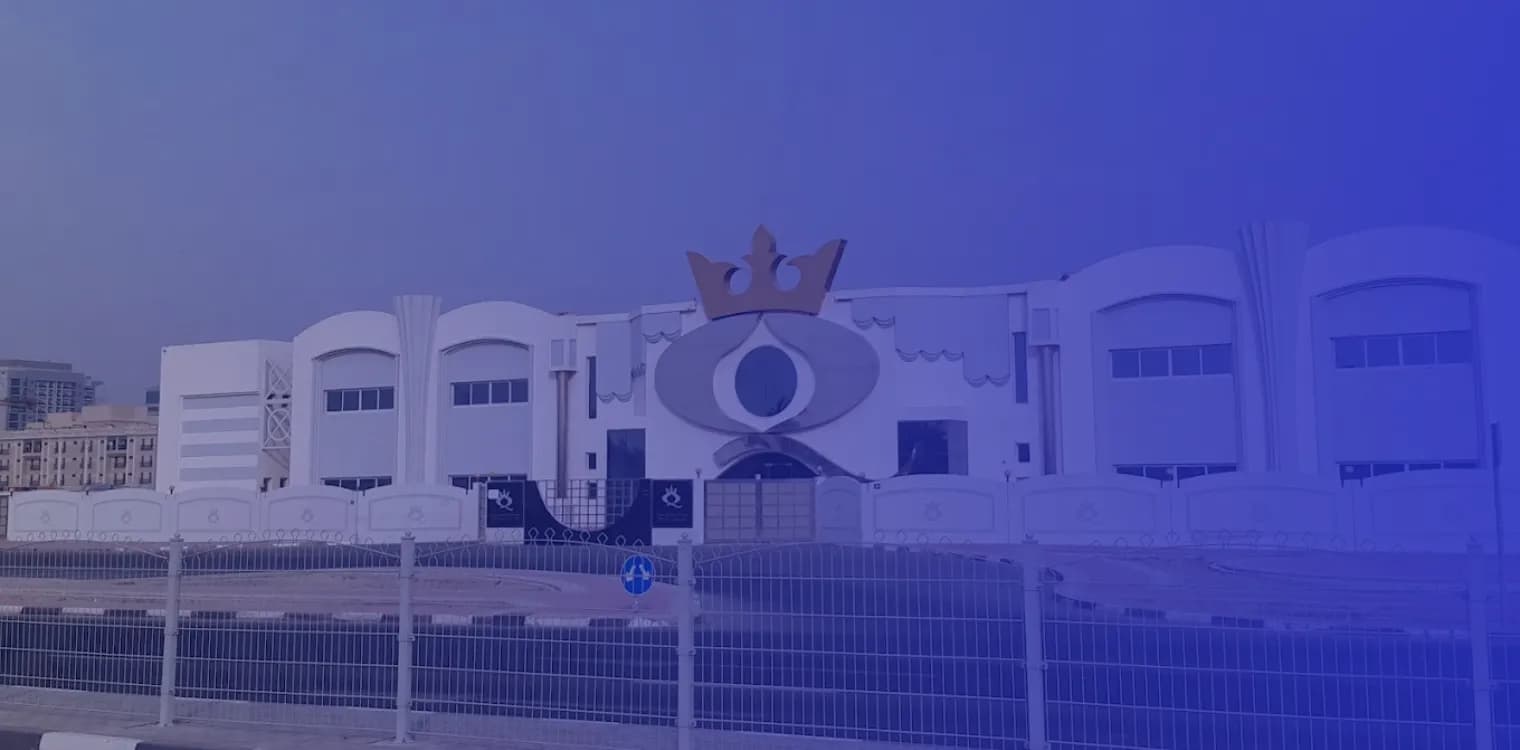
Queen International School
Are you a representative of the school? Contact us
We will help you get the information
British
Queen International School adopts the British curriculum, globally renowned for its academic quality and exceptional preparation of students for international universities.
School Facilities
Queen International School provides its students with exceptional educational facilities, including advanced scientific laboratories, a comprehensive library, and equipped sports facilities.
School Fees
About the school
Queen International School was established in Dubai in 1998 and offers a comprehensive educational experience based on the English National Curriculum. It combines solid academic programs with creative activities that develop students' skills. The school strives to create a stimulating and safe learning environment that allows every student the opportunity to excel and achieve personal growth.
Queen International School pays great attention to developing students' personalities through cultural, artistic, and sports activities, with modern facilities that support practical and interactive learning. The school also ensures a safe and encouraging environment that reflects the values of respect, responsibility, and cooperation among everyone.
Our educational vision is for students to grow and thrive in an environment that allows them to explore the world, realize their potential, develop their personalities, obtain international qualifications, learn research skills, and become lifelong learners, alongside discovering pathways to innovation and entrepreneurship in a rapidly changing world embodied by modern Dubai.
We value each child as an active contributor and work to nurture every student to develop a positive mindset that makes them a source of inspiration to others in an ever-changing and complex society.
Our mission is to provide comprehensive and strong education in a nurturing and technologically enlightened learning environment that embraces the requirements of the future. Specifically, we aim to provide the following for parents and students:
Distinguished education that enables each student to maximize their potential and strengths.
Establishing four core values: critical and creative thinking, courage in adhering to principles, ethical leadership, and calm conscious understanding.
High-quality education that motivates learners and actively engages them to achieve optimal performance in academic learning and learning for life.
An integrated pathway for character development and achieving high-level academic achievement.
An international perspective that encourages innovation and flexibility.
Immersion in, appreciation of, and understanding of the Arabic language, and conscious interaction with Dubai's environment.
Immersion in modern technologies and advanced digital facilities.
A school where everyone feels constantly welcomed and continuously engaged positively.
- At Queen International School, we aim to:
- Provide education fundamentally based on the British National Curriculum for England.
- Provide a comprehensive and balanced curriculum that ensures a solid academic foundation.
- Establish culture and traditions, good behavior, respect, and responsibility in all our practices.
- Provide education that values each student as a unique individual.
- Create a disciplined environment that enables each student to develop a love of learning.
Accredited by
Fees & Facilities
We will help you get the information
activities classes
games playground
We will help you get the information
Frequently asked questions
- Queen International School follows the UK National Curriculum to ensure global education aligned with British standards.
- A mixed and diverse learning environment that promotes cultural and social interaction.
- Modern educational facilities including science and computer labs, libraries, music and art rooms, multi-purpose sports fields, and a school clinic.
- Diverse educational and pedagogical activities including classroom programs, school events, and optional extracurricular activities.
- Strict procedures to ensure student safety including security, surveillance, transportation supervision, and the school clinic.
- The school's distinguished reputation in Dubai and its status as a well-known British school.
Application to Queen International School begins through the electronic application form on the school's official website. For more details about:
- Required application documents.
- Admission tests or assessments.
- Admission ages for each stage.
- Special conditions for sibling priority enrollment.
Please contact the school officially or visit the admissions department at its premises.
Payment methods at Queen International School: We accept the following payment methods for tuition fees:
- Electronic payment through our secure portal.
- Bank transfer.
- Cash payment at the school's financial affairs office during specified hours.
Foundation Stage
Children in the Foundation Stage receive direct educational experiences based on play, communication, and exploration. Teachers and their assistants work to provide opportunities for children to:
- Face open-ended challenges and experience problem-solving that requires innovative solutions within the curriculum.
- Contribute as digital authors, using multimedia presentations and audio and video editing tools to build their own "digital essays" on contemporary issues.
- Participate in competitions and group challenges, ranging from practical activities such as "building the tallest Burj Khalifa" using paper and tape, to initiatives like "making the school environmentally friendly" or "developing a global response plan for flood disaster in Peru."
- Participate in activities they propose themselves to improve school facilities and work mechanisms.
- Engage annually in group, leadership, outdoor, and entrepreneurial activities.
- Participate in global communication and exchanges that introduce them to international cultural diversity.
- Think about solutions to regional challenges such as water scarcity and economic diversification.
- Study "future practices" and upcoming solutions in areas such as energy generation and the transition to electric vehicles.
- Study the region's heritage, culture, and values.
All teachers and early childhood specialists work as active members of one team to:
- Face open challenges and develop creative problem-solving skills.
- Coordinate with the ICT coordinator to obtain necessary guidance, support, and training.
- Use diverse strategies to integrate technology to meet students' individual learning needs.
- Provide opportunities to use technology to support learning inside and outside the classroom independently.
- Coordinate with other departments to address topics in an integrated manner that employs ICT projects.
- Encourage students to research, analyze, and evaluate internet content that supports learning.
- Plan for repeated use of technology in various subjects.
- Use assistive technologies and appropriate software to support special education students and develop the abilities of gifted and talented students.
- Work as a team to share successes and best practices in integrating technology as a learning tool.
- Be role models in the effective use of technology.
Primary Stage
In the primary stage at Queen International School, we strive to achieve the highest possible standards in teaching and learning, ensuring that the curriculum is stimulating and challenging for all children.
The educational process includes many simulations that focus on imagination and creativity, and teachers use diverse teaching methods that enable students to achieve their maximum potential.
The main teaching and learning strategy includes:
- Focus on mastering the subject matter and the teacher's passion for it to inspire love of learning in students.
- Dynamic and fast-paced classroom teaching that pushes students beyond curriculum boundaries.
- Special attention to questioning methods, balancing complex higher-order questions with direct questions.
- Organized lessons including group and individual work, supported by stimulating educational resources.
- Regular correction of student work individually and in detail, clarifying ways for improvement and development.
- Employing Assessment for Learning (AfL) strategies to identify prior knowledge, enhance active participation, improve two-way feedback, and support differentiated instruction when needed.
The school promotes a culture of collaboration and mutual support among teachers, based on evidence-based research in curriculum implementation and teaching and learning methods, with appropriate integration of technology in all study units as a tool to enhance learning.
Secondary Stage
The secondary stage at Queen International School promotes independent learning, research, and inquiry, allowing students to have real-world experiences and opportunities to demonstrate their knowledge and skills.
Subject teaching is based on a special design that is not limited to textbooks or ready-made projects, but focuses significantly on applying knowledge. This includes a strong practical component in science, regular courses of applied problem-solving activities in mathematics, fieldwork and applied challenges in geography, and research in primary and secondary sources in history.
Subject options in GCSE and iGCSE stages vary to include: English Language and Literature, Mathematics and Advanced Mathematics, Science and Separate Sciences, History, Geography, Design and Technology, Arts, Music, Computing/Information Technology, and Physical Education. Students receive guidance to help them choose subjects that match their abilities, interests, and future aspirations, while respecting the preferences of parents and students and not restricting opportunities for test advancement without justification.
Arabic Language and Islamic Studies
The school administration works to promote the Arabic language through:
- Giving priority to teaching Arabic within curriculum objectives and professional development.
- Adopting high expectations for students' progress in Arabic.
- Integrating UAE culture, values, and language into various curriculum units as starting points for learning.
- Appointing competent and distinguished Arabic language teachers, open to professional development and cross-curricular collaboration.
- Introducing Arabic starting from FS1 stage.
- Providing special support for Emirati students.
- Periodic review of the quality of Arabic language and Islamic studies teaching.
- Demonstrating leadership by senior management through daily reference to Dubai's environment and cultural context and use of Arabic language.
- Promoting local culture through school assembly, events, visits, and school communication.
- Attracting school leaders with experience in Dubai or GCC countries when possible.
- Supporting best practices and participating in Knowledge and Human Development Authority (KHDA) events.
Arabic Language - Foundation Stage and Key Stage 1
Students arrive at school with varying levels of Arabic language skills, and planning is done to accommodate this diversity. Arabic is taught in Foundation Stage classes through daily use of the language in presentations, conversations, and boards. Children learn letters and simple words orally first, then in writing and reading, while being encouraged to form simple sentences and communicate and role-play in life situations such as school, family, shop, travel, and greetings.
Arabic Language - Key Stage 2
The main goal by Year 7 is to enable students to read and write in Arabic (beginner level), with a focus on practicing listening and speaking skills throughout primary school, and reaching at least level A2 according to the Common European Framework of Reference for Languages (CEFR). Many students progress to level B1, which includes understanding main ideas in clear texts, dealing with travel situations, writing coherent texts about familiar topics, and describing experiences and aspirations and providing reasons and opinions.
By the end of primary school, all students are expected to achieve basic A2 level requirements, which include:
- Learning the alphabet.
- Mastering letter connection and word segmentation.
- Developing a broad vocabulary.
- Studying topics such as numbers, days of the week, months, colors, animals, ordering food, describing people and places, directions, and professions.
- Communicating in simple sentences and performing basic language tasks.
- Simple expression about personal background, environment, and needs.
Arabic Language - Key Stage 3
By the end of Year 7, students become able to write a short paragraph in Arabic containing basic personal information. In Years 8 and 9, grammar skills develop to include possession and conjugating verbs in the present tense, with expansion of vocabulary related to greetings, facial parts, school supplies, house rooms, and daily routine.
By the end of Year 9, students are able to:
- Ask and answer questions about countries and capitals.
- Fill out an immigration form.
- Know and talk about time.
- Discuss hobbies and leisure activities.
- Communicate as a tourist traveling to an Arabic-speaking country.
Students also learn about restaurants and food types and expressing likes and dislikes, and learn the past tense for communication in travel situations in the Middle East. Arabic culture is an essential part of the curriculum at all stages, through resources, visits, and experiences that introduce students to daily life, local history, trade, work, Arabic literature, arts, and music, with exposure to a wide spectrum of writers and literary works.
Yes, Queen International School in Dubai is a co-educational school, meaning it receives both male and female students together in the same educational environment.
You can view complete details of tuition fees through the school's page on the Mdares platform at mdares.ai.
Activities at Queen International School
Integrated Activities and Tasks Within the Curriculum
Group challenges and practical activities in classrooms such as:
- Problem-solving and creative thinking activities.
- Digital communication activities and multimedia content production.
- Group projects to improve the school environment.
- Leadership challenges and activities outside the classroom.
- Cultural communication and exchange with other schools around the world.
These activities are part of the daily educational process and focus on developing students' life and cooperation skills.
Queen International School also organizes school and educational activities during the academic year such as:
- School Bus Safety Week.
- Student Council.
- Community Awareness Week.
- Healthy Nutrition Week.
- International Day.
- Book Fair.
- Celebrations of important national and religious days (National Day, Prophet's Birthday).
- Thematic weeks such as: Mathematics Week, Science Week, English and Arabic Language Week, and others.
- Local school trips.
- Graduation events for kindergarten students and other grades.
Queen International School's curriculum adheres to the National Curriculum for England (NCfE) framework.
Queen International School is located in Khor Al Zainz East near the Main Post Office, Deira, Dubai, United Arab Emirates.
Yes, Queen International School in Dubai provides school transportation services for students as an optional service for additional fees within the school fee items.
Queen International School facilities:
- Computer labs equipped with modern devices.
- Science labs equipped for teaching scientific subjects.
- Two multi-purpose sports fields for use in handball, table tennis, basketball, football, and volleyball.
- Music rooms equipped with a variety of musical instruments.
- Two libraries containing books and diverse reading resources.
- Art rooms dedicated to arts and creativity.
- Home economics room for developing life skills.
- School clinic with a full-time doctor.
Procedures adopted by Queen International School in Dubai to ensure student safety:
- School Security: Guards present at school gates and building entrances throughout the school day.
- CCTV Cameras: Covering most facilities and corridors to ensure continuous monitoring of student movement within the school campus.
- Entry and Exit System: Strict monitoring at school entrances to verify the identity of everyone entering or leaving, with arrival and departure registration.
- Bus Supervision: If students use school transportation services, they are monitored during boarding and disembarking from buses, with qualified drivers and supervisors.
- School Clinic: Availability of a full-time doctor and two nurses to provide first aid and healthcare when needed.
- Emergency Training: Organizing periodic drills for students and staff on rapid evacuation and behavior during emergencies.
- Safety Policies and Controls: Clear rules for students inside classrooms, playgrounds, and corridors to ensure a safe and organized environment.
Free Consultation
Get Expert Advice
Contact the school
Follow the school on social media